
Education
January 2, 2020Education / Original Objective ArticlesBy Gittan Alicia | Contributing AOJ Journalist
Backlinking
is an important part of building your website and improving search engine
optimization (SEO). Done right, backlinking will help your site and boost your
rankings by search engines. However, done wrong, backlinking can lower your
ranking, or worse, get you blacklisted by a search engine. That is why it is
important to understand what exactly backlinking is, why you should backlink,
and how you should backlink.
What is Backlinking?
Backlinking
is a fairly straightforward term. In essence, it involves the linking between
sites. In terms of your site, it is the linking from other sites to your site.
Not to be confused with the linking from your site to other sites. Backlinking
involves another site including a link to your site or content on your site,
and this link is known as a backlink. For example, you write a blog about
caterpillars and the stages they go through in transforming into butterflies,
then someone named Chris writes an article explaining the life cycle of
butterflies and includes a link to your article in his citations. This would be
known as a backlink. Backlinks can be either “nofollow” or “dofollow,” which
impact your site differently.
“nofollow” Backlinks
A “nofollow”
backlink does not give any credit to your site if someone creates a backlink to
your site. The tag “rel=’nofollow’” included in an HTML link on a website tells
search engine crawlers not to follow the link back to your site, and thus, does
not increase your website authority nor ranking. “Nofollow” backlinks neither
harm nor benefit your website, but act as a defense for sites who do not wish
to risk harming their rankings. Google also uses “nofollow” links to prevent
spam sites from ranking higher than other sites and has incorporated “nofollow”
links into its algorithm.
“dofollow” Backlinks
A “dofollow”
backlink gives credit to your site if someone creates a backlink to your site.
These links usually exclude any sort of tag and if the tag “rel=’nofollow’” is
excluded from the HTML link, the odds are that the backlink is a “dofollow” and
will impact your site rankings. As suggested by the name, “dofollow” backlinks
will be followed by search engine crawlers back to your website, and these
crawlers will report the data from the backlink back to the search engine,
affecting your website rank.
Determining whether a Backlink is “nofollow’ or “dofollow”
To determine if a backlink to your site is a “nofollow” or “dofollow” link there is an easy way to check. First, open up the browser page containing the link to your site. Next, right-click on the link and click inspect.
Look at the highlighted HTML code that opens
up on the side. If the words “rel=’nofollow’” appear, then the backlink to your
site is a “nofollow” link and does not affect your site rank. If the words
“rel=’nofollow’” do not appear, then the backlink to your site is a “dofollow”
link and does affect your site rank.
Why is Backlinking Important?
Backlinking is an important SEO tool that can improve your
site’s ranking by search engines. Search engine crawlers look for “dofollow”
backlinks from other sites to yours. If the backlinks picked up by the crawlers
are high-quality, meaning they come from reliable and authoritative sites that
are relevant to your site, your site’s ranking by the search engine increases.
However, if the backlinks to your site are from low-quality sites, meaning
their unreliable sites with little to no authority and unrelated content, your
ranking by the search engine will decrease. The idea of a backlink is to asses
how trustworthy your site is and the quality of your site’s content, which is
done by looking at other sites that link to your site.
How to Backlink
When you are backlinking for your site, you want to be more
concerned about the quality and less concerned about the quantity. This means you
will want to check the quality of the sites you want to backlink with and you
want to avoid bad backlinks that could lower your ranking. A great free tool
for checking the quality of a site you want to backlink with or a site that has
backlinked with you is MozBar.
Downloading MozBar
To download MozBar, go to www.moz.com
in a chrome browser (note that MozBar has been discontinued for the Firefox
browser, although it may be mentioned as an option on the site), then on the
top menu bar click free SEO tools and in the menu that appears click on the MozBar
link.
If instead of a dropdown menu appearing when you click free
SEO tools, a new page opens up, scroll down and click “Try Moz Bar”.
Regardless of which method you had to use, you will be brought to a page with a button that says “Download MozBar Free”, click this button and you will be brought to the chrome web store.
Once in the chrome web store, click the “Add to Chrome”
button and MozBar will be installed onto your browser. Once MozBar is installed
you will need to create an account to see site information.
To activate MozBar and create an account, you will need to
click on the little blue MozBar icon that should appear in your browser next to
the upper search bar. Once this is clicked, MozBar will activate and a bar will
appear at the top of the page. Click “create account” on this bar. (note that
if the bar does not show up as soon as you click the MozBar icon, wait a minute
or two, if it still does not show up, try searching something and opening up a
random webpage as I have done in this image)
Once you create an account for MozBar, if you are not
automatically logged in, click the MozBar icon next to the upper search bar to
turn off MozBar, wait five to ten seconds, then click the MozBar icon again. If
you are still not logged in, click the login button on the MozBar that appears
and log in. Once you are logged in, if MozBar is turned on, it will look
something like this:
Using MozBar
MozBar can give you useful insights on other sites for
consideration on whether or not they may be a good backlink for your site. You
can look at sites with relevant content to yours and look at the domain
authority of the site (DA) and page authority of the site (PA). Generally, you
would want to backlink with a website that has a high domain and page
authority.
Domain authority is a prediction of how well a website may
perform on search engine result pages, where the higher the score on a 1 – 100
scale, the better the predicted performance of a website. The domain authority
of a site is calculated using several factors. Including quality of backlinks,
and the number of backlinks. Domain authority is meant to be used as a
comparison between sites. In terms of backlinking, domain authority can be used
to look at a certain niche of sites you are trying to build backlinks from, the
higher the domain authority, the better. As a general rule of thumb, except in
special instances, you may want to aim for domain authorities of 40 and higher.
Also, note that domain authority is determined logarithmically, meaning there
is a greater gap between 60 and 70 than there is between 30 and 40 in the
scoring. Thus, it is easier to grow a site’s domain authority from 30 to 40
than from 60 to 70.
Page authority is a prediction of how well a site’s specific
page will rank on a search engine results page. Page authority is very similar
to domain authority and is based on a 1-100 scale. Several factors are used to
determine page authority, many of them similar to domain authority, however,
domain authority itself is a factor in determining page authority. Page
authority in addition to domain authority can be helpful in deciding which
sites you would like to backlink with. The page authority on a site where your
link may be included or the page including the category a piece of content you
post may be under can tell you the chances of users coming to your site and how
high quality that link may be. Just like domain authority, page authority is a
comparative tool and the higher the page authority the better.
If your website is new or you have not done much with your
site yet, do not worry if your website authority is low. The MozBar ranking
system sets all new sites at a domain authority of 0. You can improve this
score through backlinking and other SEO improvement methods, but it takes time.
Backlinking By Featured Content
One good way to increase backlinks for your site is by doing
guest blogs on other sites that feature content within your niche. You want to
make sure these are sites with good domain authority and a fairly large
audience. By guest posting on authoritative sites, you will not only be
increasing your backlinks but also be expanding and reaching a larger potential
audience for your site. You could also increase your social media following by
including your social media information in your guest post.
To find good sites to guest blog on, you could type in
search queries in a search engine that include a keyword that defines your site
plus something like “contribute”, “guest post”, “write for”, etc. You can also
take a look at your site’s competitors, these are other sites in the same niche
as you, promoting similar content. Look at the backlinks your competitors have
and any guest posts they may have made. Try guest posting on the sites your
competitors are and keep up with the type of content they’re creating. By
looking at a competitor’s content you can see what is being asked and assess
the quality of the content. If you think you can create a piece of content that
outmatches your competitor, do so, and get it featured as a guest post on the
same sites as your competitors.
To know where your competitors are guest posting, you may be able to follow them on social media to find out. Sometimes competitors will post on social media about their guest posts on other sites so their audiences will go there and check it out. This can give you an idea of the major sites your competitors are guest posting on. You could also use a paid service like Monitor Backlinks to look at your competitor’s backlinks, which can aid you in figuring out which sites to guest post on. There is also a free backlink checking service to look at your competitor’s backlinks on NielPatel, all you need to do is sign in with your Google account on the site and type your competitor’s site in the search.
When writing guest posts, you will also need to find a way
to get your content to link back to your site. There a few ways to do this. One
way is to ask the site you are writing the guest post for to include a link
back to your site. Another way is to include links to similar articles you have
written in your post. For instance, if you are writing about different types of
graphics cards, in your article as your writing you could link back to an
article you have written solely about gaming graphics cards in detail, so the
reader can find additional information from you if they are interested. Check
out this
article for more information about backlinking through guest posts.
Backlinking By Becoming a Source
You can use your expertise and writing skills to become a
source for other bloggers and journalists. Being a source means that others
quote you or link back to your site as a place where they got quality
information from. Becoming a source also has a side benefit of increasing your
site traffic and building awareness about your site.
One method to aid in becoming a source is signing up as an
expert in HARO. HARO is a free service that connects expert sources in a niche
to bloggers and journalists. In this case, you would be the expert source in
whatever niche your site is based on. HARO will send you emails from writer’s
with queries, and you can reply to those that best match your site, be sure to
include your credentials in the response. If a writer selects your response,
they may quote you in their article, though they may not always reply to your
response.
Another method to become a source is writing quality content
that may rank I search engine results. When people are researching articles,
they tend to cite similar articles that appear at the top of the search engine
results, which is why writing top-ranking content is important. Writing ranking
content is not as hard as it seems either. First, do some research by searching
topics your business would cover. In each search, look at what comes up, and
pay attention to the quality, length, and detail of each, as well as the
authority of the site that wrote it. If you think that any of these criteria
are lacking and you could create better, create that content. For instance, if
another site wrote a high quality, but a brief article on what to look for when
buying a phone case, you could rank well by expanding on that article and
providing more detail.
Backlinking by Social Media
While social media posts involve “nofollow” backlinks, which
will not improve your site’s backlinks, social media does increase your site’s
awareness. It is very difficult to backlink if no one knows about your site,
but social media can help with that. By connecting with members of social media
and building your following, your site’s awareness will increase, and with
that, so will backlinking naturally. If you gain a large enough following that
likes what you offer, your followers will repost and talk about your site,
drawing the attention of journalists and bloggers and increasing your site’s
traffic. This alone also increases the authority of your site in the eyes of
the public and sites you wish to guest post on, thus, increasing the number of
backlinks you will receive. So be sure to keep up on your social media!
Wrapping it all Up
Backlinking can be an extremely useful tool for improving your
site’s search engine rankings when done right. Make sure the backlinks to your
site are high-quality, meaning they come from authoritative and reliable sites
that are relevant to your site. Do not backlink to unreliable sites nor sites
that are irrelevant to your site, and if you see that there is a low-quality
backlink to your site, try to resolve the issue by contacting the site owner.
Remember, backlinking is less about quantity and more about quality. Reach out
to well-known authoritative sites related to your niche, create high-quality
content that can rank, and expand your social media presence and you should be
set to build your backlinking empire and improve your search engine rankings.
Want to see more content about web development? Follow me on
Instagram @gittanalicia and/or follow me on facebook @AOJ.gittanalicia
Citations:
Nica, Irina. “11 Creative (But 100% White
Hat!) Ways to Earn Backlinks in 2020.” HubSpot Blog, 16 Dec. 2019,
blog.hubspot.com/marketing/backlink-strategies. Accessed 30 Dec. 2019.Tarcomnicu,
Felix. “10 Smart Ways to Earn or Build Backlinks to Your
Website.” Entrepreneur,
14 Aug. 2015, www.entrepreneur.com/article/247984. Accessed
30 Dec. 2019.Moz.
“Backlinks.” Moz,
moz.com/learn/seo/backlinks. Accessed 30 Dec. 2019. “What
is a Backlink? How to Get More Backlinks.” WPBeginner,
www.wpbeginner.com/glossary/backlinks/. Accessed 30 Dec. 2019.“Page
Authority and Domain Authority.” LongTailPro,
23 Dec. 2019,
longtailpro.com/what-is-page-authority-and-domain-authority/. Accessed
30 Dec. 2019.“What
Are Dofollow And Nofollow Backlinks?” Mangools,
mangools.com/blog/seopedia/dofollow-nofollow-backlinks/. Accessed 30 Dec. 2019. [...]

January 1, 2020EducationFlorida
[embeddoc url=”http://aoj.scarp.info/wp-content/uploads/2020/01/SpecialtyCoffeeHouseEvaluationForm-vScarp2.pdf” download=”all”]
Maryland [...]

December 28, 2019EducationBy: Gittan
Alicica | Contributing AOJ Journalist
Building your first website can be a difficult process when you do not know what website builder is best for you. It is no secret that someone starting a business is looking to start a different type of website than a personal blogger, and depending on your desires for your website, you are going to want a different website builder.
Before you even begin looking at the different options for a website builder, you are going to need to ask yourself a few questions to narrow down what you are looking for. Ask yourself, am I developing a website with multiple pages? Am I selling products on my website, if so, are they physical or virtual? Do I offer services, if so, are they in-person or online? How much money am I willing to put towards my website? How much time am I willing to put into my website? Do I want something user friendly, or am I more concerned with doing exactly what I want to do? Do I want to have access to programming portions of my website? Am I okay with downloading additional plugins?
Perhaps write down the above questions and write out your answers so you can effectively decide what is best for what you are looking for. If you are unsure about any of the above questions, no worries, perhaps with some insight into the various website builders, the answer will become clearer. All website building platforms mentioned will be based off the questions presented above.
WordPress
WordPress is the most widely used website builder, and that
is because it can do just about everything! Whether you are building a website
with one or multiple pages, WordPress works great with hundreds of themes to
choose from so you can get the look you want for your website. If you are
selling products on your website, regardless of whether they are virtual or
physical, WordPress lets you do just that with its WooCommerce
plugin. WordPress also comes with a catalog of plugins to choose for your
website developed by other WordPress users so you can meet your websites needs,
so if you are a service-based site, there are surely WordPress plugins for you.
In terms of price, to
get the most out of WordPress, it is not free, but you can start out with the
free version to test out a variety of features and the paid version of WordPress
is fairly cheap, starting at $4 a month, not including the domain name, which
will be about $18 per year.
In terms of being user
friendly, WordPress dominates over other website builders. Everything you need to
use for WordPress is neatly organized in a sidebar on the backend of the site,
and WordPress has recently improved user-friendly features for posts and pages.
Furthermore, there are tutorials for WordPress
if you need help learning to use the website builder.
If you are a programmer like me and you are looking for a website builder that gives you the option of coding in your own additions to the site, WordPress is a viable option for you. The WordPress website builder is largely PHP based, so you will need to know PHP if you want to make any major additions. There are, however, some options to code in additions to posts and pages with HTML using WordPress. The only downside to using WordPress if you wish to code in your own additions is that you may need to setup a child theme so WordPress updates do not erase your code.
Overall, WordPress lets you do just about anything you want
to if you purchase a version of it. If you are looking for something
user-friendly that allows you to do exactly what you want to, WordPress allows
just that, however, you will likely need to be willing to download plugins. For
those who do not want to spend a million hours developing their website,
WordPress is a good option, but it does require you to manual update plugins,
themes, and WordPress itself. However, from experience, the maintenance takes
very little time at all, max 5 minutes, unless it is a major WordPress update,
which is not too often. You can also schedule when you would like to post on
WordPress. A potential problem WordPress poses for those with little time is
learning to use WordPress itself, but regardless of which website builder you
use, there will be some kind of learning curve.
GoDaddy
GoDaddy is another website builder that allows for the development of a website with one or multiple pages and offers a variety of templates to choose from for developing your website. However, if you wish to sell products on your site, starting on GoDaddy is kind of pricy. To include ecommerce on your GoDaddy website, you will need to purchase the ecommerce plan at $25 a month, which includes options for businesses providing services. In addition, you must pay for a domain name on the GoDaddy website.
If you are concerned with how user friendly GoDaddy is considered to be user friendly, but perhaps not quite as user friendly as WordPress. Just like WordPress, GoDaddy gives a great amount of room for user customization, so you can create the website you want. In terms of programming and customization, GoDaddy is based on JavaScript and does allow you to embed HTML, CSS, and JavaScript into your website. However, GoDaddy does warn that embedding code is not something to be done by beginners because it can affect the function of the entire site.
Depending on the version of GoDaddy you get, GoDaddy will automatically update and maintain your site, so you may not need to take out time for site maintenance. There are also scheduling features to schedule your posts whenever you would like on GoDaddy. Unlike WordPress, GoDaddy is not as plugin based, but you can include plugins on your site with GoDaddy Pro.
Overall, GoDaddy is similar to WordPress, but its services are a little more in depth and pricier. GoDaddy allows you to centralize all your site needs in one place, which makes it a bit pricier. You can purchase your SSL certificate and manage it from GoDaddy, get your webhosting from GoDaddy, choose and manage your emails from GoDaddy, and build your website from GoDaddy. On top of that, GoDaddy gives you the choice of either using WordPress or GoDaddy as a website builder.
Wix
Wix takes a more modern and user-friendly approach to website
development and allows for one or multiple pages. Website building with Wix includes
a drag and drop feature, which certainly reduces some of the customization
options to make the website exactly how you want it. However, if you are a
programmer, and want the website to turn out exactly how you wish, Wix may just
be the right option for you.
With their IDE and web development tool Corvid, a programmer
has access to design the website however they wish. While you code the website
with Corvid, you are given a visual on your changes. The code used for Corvid
is JavaScript and you can check out all the features Corvid provides here.
In terms of selling products and services, Wix is a viable option,
but just like GoDaddy, it will cost you extra, at least $23. You will also need
to pay for a domain name with Wix and have the option to purchase web hosting
by Wix as well, just like GoDaddy. In terms of time management for your site,
designing a site with Wix should be relatively time efficient, assuming you are
not coding. Also, your purchase of a premium Wix Plan comes with Wix
Webhosting, which will setup your site for you and manage your sites security.
Conclusion
Given the
descriptions and information about these website builders, hopefully you have
somewhat of an idea about what website builder you would like to choose. If you
are wondering, the AOJ website you are reading this on was built using
WordPress, which from my own personal experience, I would recommend for its
vast amount of available customization so you can design your website exactly
how you want. WordPress’s plugins are also very useful for adding features that
may not be built into the WordPress site. For more information on using
WordPress to develop your website, check out my article How
to Setup a Website Like We Did.
Good luck on
your website building adventures! [...]
October 27, 2019Education / Original Objective ArticlesGittan Alicia | Contributing AOJ Journalist
A website can be a very important aspect of a business, depending on the type of business and its stage in growth. In our case, a website was essential, our entire company is based on our unique take as a journalism business and our branding depends heavily on our website. Not only that, but where else are we going to post our articles and blogs so they can be freely associated with our values? Thus, we created a website via WordPress and this blog post will tell you how you can too!
We started by finding a host for our website. Of course, you could sign up for the free version of WordPress without another hosting service, but for the greater freedom and customization of our site, to run the site securely, and to create emails associated with the site, we found a separate host (A2 Hosting). There are several hosts supporting WordPress that you could find, but first you should assess what host would work best for your goals, and whether or not you even need a separate host from WordPress at all. This will require a bit of research, and you should definitely look at several web hosts to determine what works best both financially and functionally. Also, note that several web hosts support WordPress, but there are also several that don’t. The same applies to other website development platforms. This blog will only cover designing a website with WordPress.
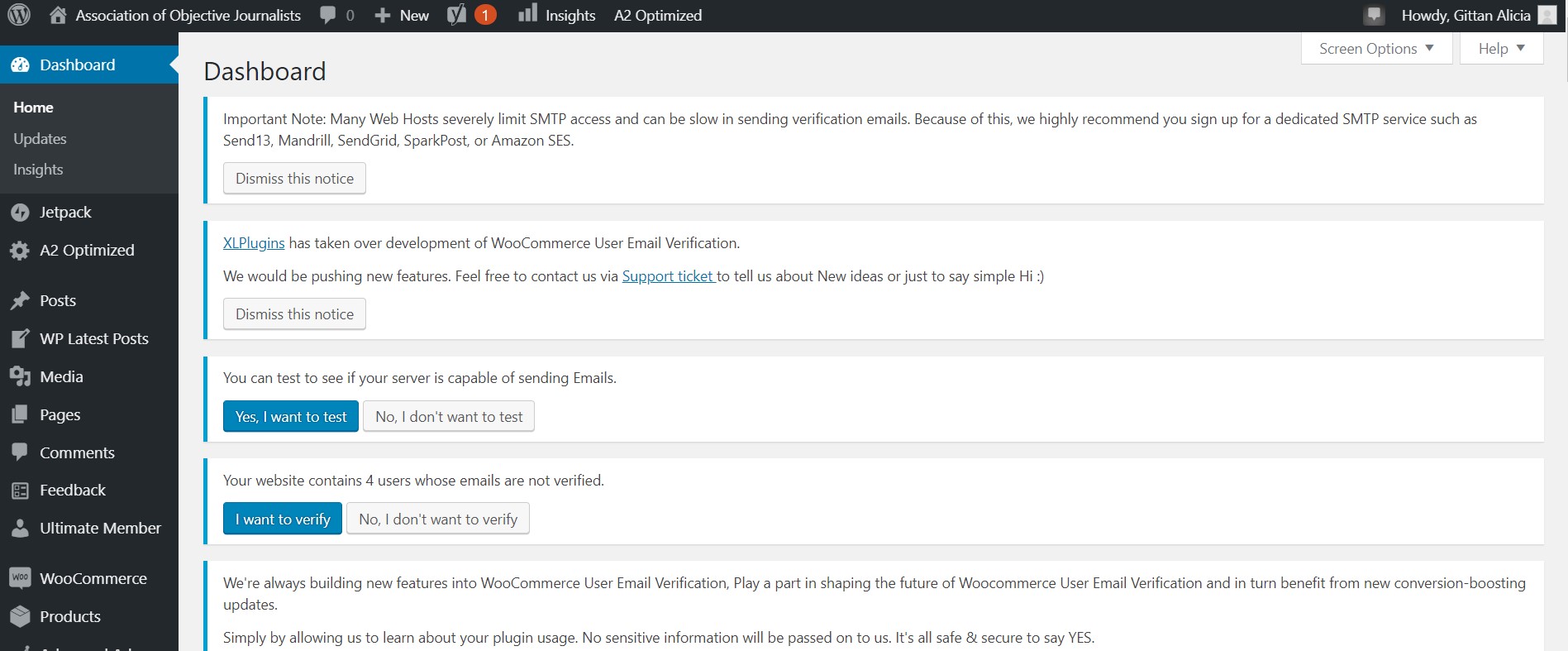
At first, WordPress can be a little overwhelming, and you may be looking at all those features wondering what in the world you are supposed to do, but do not fret, you will figure it out and many of those features are not as scary as they seem. I will first give you a brief overview of the side panel you will see in what is known as the “back end” of your site. The “front end” of a site is what your site visitors will see, and the back end is only what you and other people you may give access to edit your site may see. The back end should look something like this:
Do not worry if your backend does not look exactly like mine, I have added some extra plugins for my business needs, which I will explain later. The most important side panel features are posts, categories, media, pages, comments, appearance, users, tools, settings, and depending on the business, WooCommerce and products. That may seem like a lot, but it really is not, it is just enough to do most of what you want to do. You can learn how to use each of these side panel features on the WordPress site itself, or through YouTube videos. Your website may not come with WooCommerce as a plugin, but if you are selling products on your site, WooCommerce is a well-rated plugin to use and you can download it by searching on the plugins page, which can be accessed by clicking plugins on the side panel.
One of the first things you will want to look at when setting up your site is themes. Click on appearance on the side panel and then themes to access your themes and the database to search for more themes to use. Look through these themes and read up on them. You will probably want to use a free theme, but be sure to find one that allows for the format you would like to incorporate into your site that would work best for your business. For instance, AOJ used a theme with a grid layout, because that was how we wanted to organize our posts, and it was the most suitable for what we do, which is write articles.
There are
also several essential features to a website. You will want a home page, and
this homepage will need to make a clear statement to your audience about what
your business is or who you are. You will want to incorporate branding that
accurately defines your business or person. You will want a logo of some sort,
this should be relatively simple, relate to your business or person, and leave
the reader with a clear impression of your business. Our AOJ logo shows we shine
a light on truth with our articles.
You will also want to include your name or business name, and this should be simple and memorable. If your site visitor cannot remember your name or do not know your name, they may not come back. We think, “objective journalists” is an easy slogan to remember for our website, and in fact, you can find us at aoj.scarp.info. A slogan may also be useful in defining your business. Lots of business and people add taglines, for instance, Nike has “just do it”, and Meow Mix has the slogan “Tastes So Good, Cats Ask for it by Name”.
Of course,
there are so many other features of a website to look at as well. You may want
to take a look at the plugin features. These allow you to incorporate other
features into your site that are not already provided by default in WordPress.
So, look at these other features and plugins and see what works best. If
something doesn’t work, there are so many other things to try. Do not be
discouraged, because with your website there is flexibility, and if worst comes
to worst, you can easily change your site. A website is yours to customize and
create, so have fun with it! [...]
August 5, 2019Education / Original Objective Articles By: Doktor Prax Evad | Contributing AOJ journalist
Learning theories that center around cognition seem very appropriate to human learning and appear particularly useful when examining problem solving. Even some behaviorists attribute cognition as an important element of learning. E. C. Tolman (1948) believed that behavior was guided by purpose. Organisms selectively take in information from the environment and build up cognitive maps as they learn. From cognition learning and associated theories, such as schema theory, it can be hypothesized that cognitive maps or schema are enhanced by learner errors. The contribution of error making to learning is the subject of this paper. Parts of various theories are directly impacted by error making with respect to the learning process. These theories are identified and expounded upon with regard to error making; thereby, arriving at new theories or insights to previous theories.
Errors Relate New Information to Existing Schema by Specifying Differences
Encoding is an aspect of cognitive theory and memory that is directly impacted by a learner making errors during the learning process. “Encoding refers to the process of relating incoming information to concepts and ideas already in memory in such a way that the new material is more memorable. Left to their natural inclinations, humans will always try to make things meaningful, to fit some new experience into the fabric of what they already know.” (Driscoll, 2000, p. 91). Errors make new experiences more meaningful by relating differences between what already is in memory and providing guidance on what a thing is not. For example, suppose a child already has in memory that a dog has four legs and then encounters a horse. The child may refer to the horse as a dog. This error might be corrected by the parent causing the child to identify differences between a horse and a dog, such as size or a mane. The new definition of a horse now has greater meaning to the child.
The
example given in the previous paragraph describing how errors lead to
identified differences and similarities also relates to the theory of
correlative subsumption. When defining
subsumption Driscoll (2000) stated that
“The principal way of adding information to cognitive structure, in
Ausubel’s view, is to attach new ideas and details in a subordinate fashion to
the anchoring ideas already present…More typical of the way most learning
occurs, according to Ausubul, is correlative subsumption. This process refers to elaboration,
extension, or modification of the previously learned concept or proposition by
the subsumption of the incoming idea.” (p. 120). Part of cognitive structure is also what
things are NOT. Differences are often
more meaningful than similarities and making errors allows identifying
differences. Interestingly, when engaged
in a process where errors occur and a learner’s concept or result proves true,
rather than in error, more confidence in the result and a stronger connection
to the concept or result is made thanks to previous errors.
When
existing schemata evolve to become more consistent with experience, then tuning
has occurred. Rumelhart and Norman
(1978) suggested that this process accounts for the minor schema modifications
that come with new exemplars of concepts and principles. This indicates that errors help tune schema
and are not only used by novices while instituting trial and error techniques,
but are also used by experts to tune current schema.
In
tuning schema, errors help assure that the new information added to your
current schema is uniquely relevant to and suitable to the learner. Errors allow you to gather more information
that more appropriately fits your schema than delivered reception, such as
information delivered directly from a teacher.
These errors are also the errors to which you may personally be prone,
and therefore, need to learn.
Dispositions and one’s unique schemas change how you will react to
learning and new information. Errors
assure that new information is customized to the learner’s disposition. “Encoding performance does not occur in a
vacuum: perceptions are framed in context and result from a dynamic interaction
between characteristics of the performance context and individual dispositions”
(Iigen, 2000, p. 3).
Problem Solving Requires Exploration and Inherent Mistakes
Exploration is a technique of
learning that has proven very effective and is particularly apt when problem
solving is required. For novices,
exploration is often accomplished through trial and error since without a base
of knowledge it may be difficult to at first form specific goals and intentions. At the other extreme, experts perform
exploration using a systematic approach where hypotheses are tested against
expected and non-expected results (errors).
“Systematic exploration is an optimal pattern of behavior that leads to
the highest probability of successful task completion. The term systematic
refers to the process in which a person forms goals and intentions based on
hypotheses about how the task should be done. These hypotheses are tested in a
logical manner and outcomes are evaluated in order to plan further behavior” (Van
Der Linden, Sonnentag, Frese, & Van Dyck, 2001, p.190). Errors or mistakes in the learner’s
hypotheses are expected as they progress through the process, and these errors
force the learner to continuously reevaluate and sharpen their hypotheses. No other learning technique provides as much
guidance as systematic exploration due to its nature of constantly evaluating
mistakes and errors, as well as the (typically less frequent) successes.
Reception learning is essentially the same
as what commonly occurs in expository instruction, where learners are told
information rather than discovering it for themselves. Science textbooks, for
example, state principles and provide examples of their applications. Errors in reception learning play a small
role in achieving understanding. By
contrast, discovery learning is accomplished where students derive
understanding from their exploration, such as through experiments from which
they derive the understanding of scientific principles. The benefits of discovery learning over
receptive learning are based on the ability to make mistakes from which one can
easily learn and the broader understanding inherent in testing your schema
against unknown variables and conditions.
Guided Error Learning Compared To Exploration
Errors
can be made intentionally as directed by instruction and as part of the
learning process using a technique referred to as guided error learning. Guided error learning is not as effective as
explorative learning that produces errors because the learner attributes guided
errors to something that was supposed to happen. Since the error was intended, there is little
surprise to focus learner attention and fewer opportunities to develop
metacognitive skills. In addition,
guided errors probably are not the same errors that a learner would naturally
make, and therefore, are less applicable to the learner’s schema or tuning that
schema.
Simulators
and games offer an environment where guided error learning or explorative error
learning can take place and where theory is closely connected to real-life
experiences without fear of real-life consequences (Henry, 1997). For the reasons stated in the previous
paragraph, simulators and games are better tools for learning if there are
non-prescribed errors, which implies explorative error learning. While teaching classes at New York Power
Authority using a power system simulator, I have observed the benefits of
explorative error learning over guided error learning. The students were given labs to complete with
guided errors included. The students had
difficulty identifying why the errors were important and relating the errors to
how they actual use the system. During
free-time (explore the simulator program on your own) after a lesson, the
students gained significant proficiency in using the program if I was available
to answer the questions as they explored and made mistakes. Note that the students all had different
questions using the computer in reference to the lesson previously
provided. The differences indicate that
they all have unique schema that are tuned with unique information; hence,
explorative error learning was superior to guided error learning.
Simulation
or games are good methods of teaching problem solving because they allow schema
transfer through application, which is the next subject to be covered. Application is critical due to its
explorative nature where one feels or finds their way to the solution by making
mistakes. These mistakes or errors guide
the learner to the solution keeping the learner on a proper path for that
specific learner.
Invoking Relevant Schema
Errors make one raise the question, “why is an
answer inappropriate?” and facilitate transfer or application of schema. It is crucial that schema not only be
properly formed, but also that the proper schema are applied to new problems
through a process known as transfer.
Errors in explorative learning enhance the learner’s ability to invoke
relevant schema in new situations.
“Schema theory is more comprehensive than meaningful reception learning
in being able to account for how learners bring to bear what they know on
solving problems. But neither theory is
focused particularly on how people learn when to use their knowledge. Although transfer may be a matter of invoking
relevant schema, determining when a schema is relevant turns out to be no easy
task.” (Driscoll, 2000, p.149) Perhaps,
people learn when to use their knowledge under various schema based on errors
indicating when the knowledge is inappropriate to the situation.
Working on problems or looking at problems from
multiple angles with multiple examples helps students learn why mistakes are
made and ultimately develop a proper schema for the problem type. “It is possible that when errors are present
the performer has to create hypotheses about how to correct them and, thus,
adopts a selective learning strategy.
When errors are absent, there is no need to test hypotheses because the
movement is effective (successful).
Therefore, participants who do not make errors may adopt an unselective
mode of learning by default.” (Maxwell, Masters, Kerr, & Weedon, 2001, p. 1052)
Errors and Motivation
Making errors can have a dubious effect on one’s motivation, which is also critical to the learning process. However, errors can be made with positive effects when the learner is placed in a positive learning environment since a learner understands they are to make mistakes in such an environment. It is important to let the learner know that such mistakes are expected and encouraged as part of the learning process. As an instructor, consider treating wrong answers as successes and expected outcomes during the learning process. At work when teaching a new employee to develop training material, the employee seems to do better over the several draft iterations when I warn them upfront that I will almost undoubtedly markup their drafts extensively while they learn our process and that this is to be expected. Since these mistakes are expected, they have less of an impact on motivation than in a non-learning environment.
Errors can help a learner become more motivated through increased attention. For example, task complexity or difficulty is a factor that influences selective attention. An indication to the learner of task complexity or difficulty is making mistakes or errors while working on the task. Selective attention helps take information from sensory memory and transfer it to working memory.
Striving
to succeed and treating errors as motivational allows the learner to focus on achieving
difficult answers. I refer to this
concept as the obsession factor. When I am working on a task, such as
installing software, I become more focused on my task as I encounter more
problems (mistakes or errors in my schema).
To tune my schema and adapt, I focus harder on the problem to overcome
it. If a task is simple, less learning
usually results due to less attention and less input of new information through
errors to my schema. Beware of striving
for unobtainable goals in learning or the learner will lose confidence and/or
hit frustration. “When learners
encounter instruction that makes no sense to them, it becomes an impossible
task to call upon prior knowledge, because there is no way to judge what knowledge
will be relevant.” (Driscoll, 2000, p.144)
Errors Give the Learner Confidence in the Correct Answer
Errors give the learner confidence
in the correct answer by assuring that feedback is working properly. An example is the time I taught an energy
management system computer course. The subject
on which the learners performed worst was emergency rotating load
shedding. This subject was taught in
simulation mode but the simulation was not working properly and feedback was
not given, such as a switch open symbol after opening a switch. Without this feedback, the learners had no
idea whether they were doing tasks properly or improperly.
The trial and error technique works on the same principle of requiring feedback of errors or successes so that the learner has confidence in the correct answer. Illustration of this principle is shown in some of Thorndike’s research. Thorndike was particularly interested in discovering whether his animals could learn their tasks through imitation or observation (Kentridge, 2001). He compared the learning curves of cats who have been given the opportunity of observing others escaping from a box with those who had never seen the box being solved and found no differences in their rate of learning. He obtained the same null result with dogs and, even when he showed the animals methods of opening a box by placing their paws on the appropriate levers and so on, he found no improvement. He fell back on a much simpler trial and error explanation of learning. Occasionally quite by chance, an animal performs an action which frees it from the box. When the animal finds itself in the same position again it is more likely to perform the same action again.
Proper Feedback Is Critical to Learning from Errors
As alluded to in the previous
section on confidence, proper feedback is critical to learning from
errors. Errors without feedback are less
instructive than errors with feedback.
Feedback can be achieved through self monitoring or provided externally. Feedback has been found to be an important
instructional variable in improving student achievement. Research by Clark and Dwyer (1998) shows that
“in computer-assisted instruction, feedback is a very important external
condition that can be manipulated to positively effect the learner’s
performance…Kulhavy found feedback after incorrect response to be effective in
facilitating learner achievement…When confidence is high in an error response,
feedback acts as a strong corrective device, and the resulting facilitation
tends to maintain itself over a retention interval” (p. 1).
Based
on the separation between the error itself and the error consequence it is
useful to differentiate between three types of error consequences as identified
by Van Der Linden, Sonnetag, Frese, & Van Dyck (2001). First, negative
consequences for direct goal attainment (e.g. errors that block further
effective behavior or errors that destroy earlier constructive work). Second,
non-effective actions: erroneous actions that do not have any direct effect at
all (e.g. pushing non-active buttons or other worthless attempts). Finally,
actions which are in essence wrong (do not lead to the intended goal) but might
lead to insight in solving the task being performed (positive error
consequence).
Note
that errors can teach dysfunctional behavior if goals are specified incorrectly
or with lack of precision and consequently reinforcers are applied. This theory is based upon Thorndike’s Law
of Effect: “When a modifiable connection
between a single situation and a response is made and is accompanied by a
satisfying state of affairs, that connection’s strength is increased. When made and accompanied by an annoying
state of affairs, its strength is decreased.” (1913, p. 4)
Suggested Additional Components to Improve My Errors Enhance Learning
Theory
To
improve my existing theory, a study of the weighted relationship between errors
and successes would prove useful. This
information would provide insight to the degree which errors influence
learning. The analysis would need to be
with regards to different types of learning, such as rote, problem solving,
etc.
Another
way to improve the theory would be to add a component on optimal angles from
which to approach a problem. The optimal
angles or contexts would need to address how errors interrelate from these
various angles of attacking a single problem or performing a single task. I am curious to know if there is a non-linear
increase in understanding based on a multiple angles approach.
Summary
Based on research performed by
others and anecdotal evidence of my own experiences, performing errors and
making mistakes during the learning process enhances a learner’s schema. Errors add additional information to the
schema that is tailored to the individual learner and more readily fits into or
adjusts their schema. Additionally,
errors can be a positive motivational factor by focusing selective attention in
the proper learning environment. Perhaps
the most important benefit of errors and mistakes is in the area of applying
relevant schema to new tasks and problems.
Errors make one raise the question, “why is an answer inappropriate?”
and facilitate transfer or application of schema.
References
Clark, K. & Dwyer, F. M.
(1998). Effect of different types of
computer-assisted feedback strategies on achievement and response
confidence. International Journal of
Instructional Media, 25, 55-63.
Driscoll, M. P. (2000). Psychology
of learning for instruction (2nd ed.). Needham Heights, MA:
Allyn and Bacon.
Henry, J. M. (1997). Gaming: A teaching strategy to enhance adult
learning. The journal of continuing
education in nursing, 28, 231-234.
Iigen, D. R. (2000). Bearing bad news: Reactions to negative
performance feedback. Applied Psychology, 49, 550-566.
Ivancic, K. & Hesketh, B.
(2000). Learning from errors in a
driving simulation: Effects on driving
skill and self-confidence. Ergonomics,
43, 1966-1984.
Kentridge, R. W. (2001) Operant
conditioning and behaviorism – an historical outline. Paper was restructured from a lecture.
Maxwell, J. P., Masters, K. E.,
& Weedon, E. (2001). The implicit
benefit of learning without errors. The
quarterly journal of experimental psychology, 54A, 1049-1068.
Rumelhart, D. E., and Norman, D. A.
(1978). Accretion, tuning and
restructuring: Three modes of learning.
In J. W. Cotton and R. L. Klatzky (Eds.), Semantic factors in
cognition. Hillsdale, NJ: Erlbaum.
Thorndike, E. L. (1913). Educational psychology. Vol. II. The
psychology of learning, New York: Teachers College, Columbia University.
Tolman, E. C. (1948). Cognitive maps in rats and men. Psychological review, 55, 189-208.
Van Der Linden, D., Sonnentag, S.,
Frese, M., & Van Dyck, C. (2001).
Exploration strategies, performance, and error consequences when
learning a complex computer task. Behaviour
& Information Technology, 189-198. [...]

September 16, 2018Education / Original Objective ArticlesBy: Doktor Prax Evad | Contributing AOJ journalist
Our current educational system is holding back students and encouraging mediocrity. Like the Model T factories of yore, our educational facilities seek to intake every student and output a standard model with little deviation.
This is an injustice to our students and to our country. If the US is to hold onto its technological prowess and reputation as the home of a skilled, productive workforce, it needs to adapt its education system. I am not talking about common core or charter schools or any standard proposals making the rounds, I’m talking about dramatic alterations to our education system.
The structural limitations of our grade system are holding back excellent students. The line between Elementary, middle, and High school should be removed. The difference between one grade level and the next grade level should be fluid. Even the transition between high school and college could be re-imagined as an adaptable, non-rigid process.
One of the fundamental differences between American and European models of education lies in the methods of sorting students into careers. The US does not generally track students from a young age toward a particular career path. My view is that this is an appealing part of the American system. Students can choose their own path, but there are still countless issues in our educational system. One that I seek to address, at least partially, is the tendency for our school systems to limit the success of students by holding them down to heavily structured curriculum, rather than allowing specialization and depth. We choose breadth. That breadth of topics covered in our school system is vital, but needs to be balanced against the legitimate desires and capabilities of students to excel. One way to begin removing these barriers to excellence is removing grade levels. Without such classifications of students, school system can develop more adjustable schedules for its students and students can more easily take classes at higher levels without as great a likelihood of interference with other classes.
Further, the prevailing 2 semester system should be redesigned in a more adaptable way. Consider a system wherein the year is divided into 4 equivalent terms, with students granted one term off every year. Online courses are also essential to raising the adaptability of school to meet students’ needs. At the same time as students are taking their regular course load, they should be allowed to enroll in an additional online course in case of scheduling conflicts during the school day, to encourage students to reach further into the curriculum. This might also allow students to easily graduate earlier if they so desire or gain valuable skills in preparation for college. For instance, let’s say a student wants to go into computer science, but the computer science course they want conflicts with an English course requirement. It should be possible to take one of those courses outside of school, as an online alternative. I would also note that perhaps having some upper level course requirements serves no use for some students. For instance, if Charlotte is set on becoming a graphic designer, what good would upper level math serve her? A basic level of math is important to everyone, but there is certainly a point where that math serves to take time away from taking something more important to an individual student’s future.
Onto my next point, the bounds between high school and college should be blurred a bit. It is important to get a high school degree and I am not arguing to remove that, but students should be able to take college classes at their local community college at no cost and for high school credit plus, potentially college credit. I also don’t think there should be strict age limits on when students can take college courses. If a student wants to try a college course let them. To prevent utterly destroying GPAs (if we still want such constructs), perhaps allow a pass fail option. And obviously allow retaking courses.
Students should be allowed to test into any level course they can handle regardless of age. Without a grade level system, this will streamline that process and reduce negative competitive burdens. For instance, without a grade level, there isn’t a class rank to fret over. Students can focus more on learning, rather than beating peers.
Beyond all these recommendations, standardized testing needs some serious re-evaluation as a means of college admissions. Either we need to remove standardized testing from admissions or make preparation for such tests as accessible as possible to prevent parents from buying their kids’ way to a good test score through tutoring. Such a system serves to promulgate inequalities, rather than meritocratically reward those most qualified for admission.
Citations:
European Commission/EACEA/Eurydice, 2017. The Structure of the European Education Systems 2017/18: Schematic Diagrams. Eurydice Facts and Figures. Luxembourg: Publications Office of the European Union. [...]